The Convergence of Solana and Prediction Markets
Why sub-second settlement and custom oracle architecture make Solana the definitive chain for on-chain prediction trading
The only study in this domain so far.
All of Web3Summary
Why sub-second settlement and custom oracle architecture make Solana the definitive chain for on-chain prediction trading
- Published
- Filed under
- Web3
- Reading time
- 10 min read
- Sections
- 9
- Research by
- Venym Labs Research
Published by Venym Labs. Methods and limits are in the study; it has not been peer reviewed.
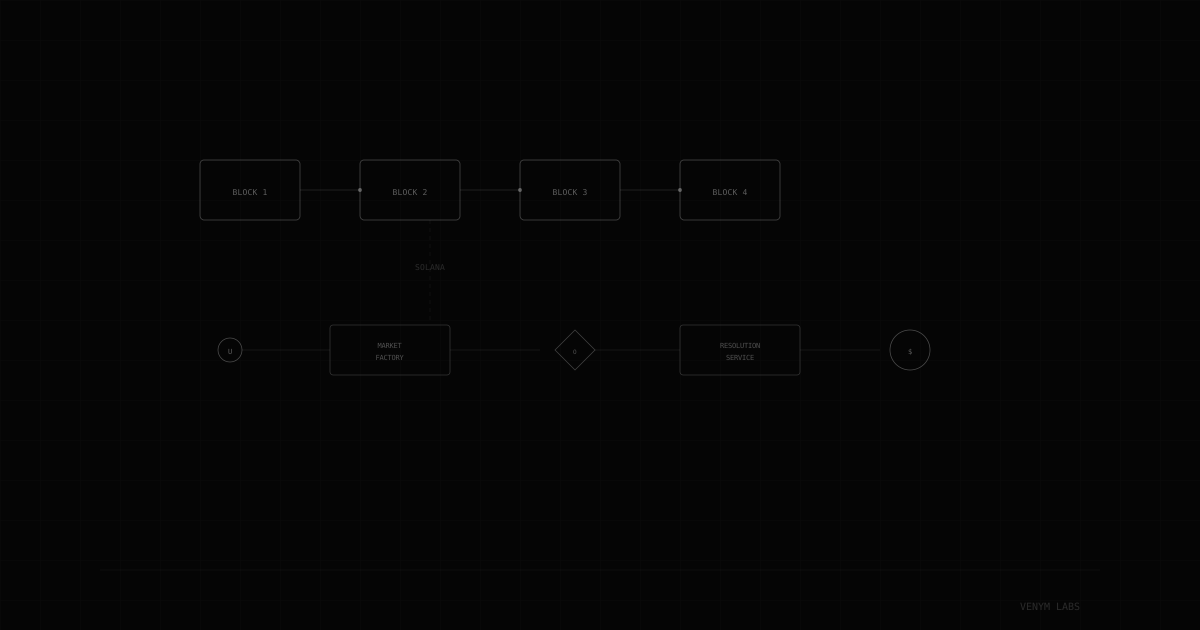
The Convergence of Solana and Prediction Markets#
Why sub-second settlement and custom oracle architecture make Solana the definitive chain for on-chain prediction trading#
Prediction markets are one of the most compelling applications of blockchain technology — they create economic incentives for truth-telling, aggregate distributed information, and provide probabilistic forecasts on real-world events. But most on-chain prediction markets have failed to achieve product-market fit.
The reason is simple: the underlying chains were too slow.
When market resolution takes minutes, settlement takes hours, and oracle updates lag by seconds, you can't build the real-time trading experience that makes prediction markets engaging. Solana changes the calculus entirely.
At Venym Labs, we built HELM — a prediction market system on Solana — and the architectural decisions we made reveal why Solana is the natural home for this asset class.
The Prediction Market Trilemma#
Prediction markets on-chain face three competing demands:
         Speed
        /     \
       /       \
  Accuracy   Decentralization
- Speed: Traders need real-time price updates and instant settlement
- Accuracy: Oracles must deliver correct resolution data
- Decentralization: No single party should control outcomes
Most existing systems optimize for one at the expense of others:
| Platform | Speed | Accuracy | Decentralization | Chain |
|---|---|---|---|---|
| Polymarket | ~5s UI, ~15min settlement | High (UMA) | Medium | Polygon |
| Kalshi | ~1s UI, CEX-speed | High (regulated) | Low (centralized) | Off-chain |
| Augur | ~15min+ | Medium (crowd-sourced) | High | Ethereum L1 |
| HELM | ~400ms | High (custom oracle) | High (Solana) | Solana |
Solana's 400ms slot time and sub-second finality allow HELM to operate at speeds comparable to centralized prediction platforms while maintaining full decentralization.
HELM Architecture#
Market Factory#
The Market Factory is a Solana Anchor program that handles market lifecycle:
#[derive(Accounts)]
pub struct CreateMarket<'info> {
    #[account(mut)]
    pub authority: Signer<'info>,
    #[account(
        init,
        payer = authority,
        space = Market::SIZE,
        seeds = [b"market", market_id.key().as_ref()],
        bump
    )]
    pub market: Account<'info, Market>,
    pub system_program: Program<'info, System>,
}

#[account]
pub struct Market {
    pub market_id: Pubkey,
    pub question: String,           // "Will BTC reach $100k by Dec 2025?"
    pub outcomes: Vec<String>,      // ["YES", "NO"]
    pub resolution_time: i64,       // Unix timestamp
    pub oracle: Pubkey,             // Custom oracle authority
    pub shares: [u64; 2],          // Outstanding shares per outcome
    pub resolved: bool,
    pub winning_outcome: u8,        // 0 or 1
    pub total_volume: u64,          // In lamports
    pub bump: u8,
}
Trading Mechanics#
Trading in HELM uses an automated market maker (AMM) model within each market:
- Yes shares + No shares = 1.0 (constant sum)
- Price of YES = Yes shares / Total liquidity
- Price of NO = No shares / Total liquidity
This creates a natural pricing mechanism where the market reflects the consensus probability. A YES price of $0.65 means the market believes there's a 65% chance the event occurs.
The Oracle Decision: Why We Removed Pyth#
This was our most consequential architectural decision.
The Case for Pyth (Initially)#
Pyth Network is Solana's primary oracle infrastructure. It provides:
- High-frequency price feeds from institutional data providers
- Pull-based model (updates on-demand)
- Sub-second update latency
- Battle-tested on Solana
For perpetual futures or lending protocols, Pyth is excellent. For prediction markets, it has fundamental limitations.
The Case Against Pyth (For Prediction Markets)#
-
Price feeds ≠ Event outcomes. Pyth provides asset prices. Prediction markets need binary/categorical event resolution. "Will the Fed cut rates?" is not a price.
-
No custom event types. Pyth's data model is rigidly structured around financial prices. You can't query "What percentage of the Senate voted yes on bill X?"
-
Resolution timing mismatch. Pyth updates continuously. Prediction markets resolve at specific times based on specific criteria.
-
Dependency risk. Relying on Pyth for prediction market resolution creates a single point of failure for a function Pyth wasn't designed to serve.
Our Custom Oracle Design#
pub struct CustomOracle {
    // The event being tracked
    pub event_query: String,          // e.g., "BTC_price_above_100k"
    pub resolution_source: String,    // e.g., "coinbase_spot_price"
    pub resolution_criteria: String,  // e.g., "price > 100000 at timestamp"
    pub threshold: f64,                // e.g., 100000.0
    pub comparison: ComparisonType,    // Above, Below, Between, Equals
    pub resolution_time: i64,          // When to check
    pub resolved: bool,
    pub outcome: bool,
    pub data_sources: Vec<DataSource>,
}

pub struct DataSource {
    pub url: String,
    pub weight: f64,
    pub last_value: Option<f64>,
    pub last_checked: i64,
}
The resolution service works as follows:
1. Market reaches resolution_time
           │
           ▼
2. Resolution service wakes up
           │
           ▼
3. Polls all configured data_sources (3-7 sources)
           │
           ▼
4. Aggregates: median with staking-weighted override
           │
           ▼
5. Applies resolution_criteria to aggregated value
           │
           ▼
6. Submits resolution transaction to Market Factory
           │
           ▼
7. Market Factory updates market state, enables share redemption
Why This Works Better#
| Feature | Pyth | Custom Oracle |
|---|---|---|
| Event types | Prices only | Any (prices, votes, outcomes, ranges) |
| Custom logic | No | Fully configurable |
| Resolution timing | Continuous | Event-specific |
| Multi-source | Yes (aggregated) | Yes (configurable) |
| Fallback | No | Yes (multiple sources with weights) |
| Cost | Oracle fees | Transaction fees only |
Centralized vs On-Chain Prediction Markets#
Latency and Settlement: The Solana Advantage#
Transaction Lifecycle on Solana vs Ethereum L1#
| Metric | Ethereum L1 | Solana | Arbitrum | Polygon |
|---|---|---|---|---|
| Block time | ~12s | ~400ms | ~250ms | ~2s |
| Finality | ~12 min | ~1-2s | ~10 min | ~5 min |
| Tx cost | $1-50 | $0.00025 | $0.01-0.10 | $0.01-0.05 |
| TPS | ~15 | ~65,000 | ~40 | ~7,000 |
For prediction market trading, this matters enormously:
-
A trader sees breaking news. On Ethereum, their trade settles in 12+ minutes. On Solana, it settles in under 2 seconds. The information advantage decays rapidly — by 12 minutes, the market has already moved.
-
Market resolution. On Ethereum, the oracle update + settlement takes multiple blocks (2+ minutes). On Solana, the entire resolution pipeline completes in under 3 seconds.
-
Share redemption. After a market resolves, winners need to redeem shares. Fast finality means winners can immediately redeploy capital into new markets.
Real-World Impact#
Consider a political prediction market during an election night:
State 1: Polls close in key state (9:00 PM)
         ↓
State 2: Early results leak on Twitter (9:02 PM)
         ↓
State 3: PerpsTrader detects signal (9:02:01 PM)
         ↓
State 4: Trade submitted to HELM (9:02:02 PM)
         ↓
State 5: Trade confirmed and settled (9:02:03 PM) ← SOLANA
         vs.
State 5: Trade still in mempool... (9:02:15 PM) ← ETHEREUM
State 5: Trade confirmed... (9:14:00 PM) ← ETHEREUM
State 5: Trade finalized... (9:26:00 PM) ← ETHEREUM (finality)
By the time the Ethereum trade is finalized, the market has already moved significantly. The Solana trader captured the full alpha.
Market Resolution Mechanisms#
HELM supports multiple resolution types:
1. Threshold Resolution#
Binary event: Does value X exceed threshold Y at time T?
- Example: "Will BTC be above $80k on March 31?"
- Resolution: Check BTC price at 23:59:59 UTC on March 31
2. Range Resolution#
Categorical event: Which range does value X fall into?
- Example: "Where will ETH close Q1? A) <3k-4k"
- Resolution: Check ETH price at quarter end, map to range
3. Index Resolution#
Composite event: Does a computed index meet criteria?
- Example: "Will the Crypto Fear & Greed Index be above 75?"
- Resolution: Poll multiple sources, compute index, compare to threshold
4. Manual Resolution (Escrow)#
For events without automated data sources:
- Market creator posts bond (escrowed in SOL)
- Resolution committee (staked participants) votes on outcome
- Disputes handled via slashing mechanism
The Economics of Fast Prediction Markets#
Speed isn't just a UX feature — it's an economic engine. Here's why:
-
Higher turnover. Sub-second settlement means traders can cycle capital through multiple markets per day, increasing total volume and platform fees.
-
Tighter spreads. Fast resolution reduces uncertainty premium. Market makers can quote tighter spreads when settlement risk is near-zero.
-
More markets. Lower transaction costs and faster settlement enable markets on shorter time horizons (intraday, hourly) that would be uneconomical on slow chains.
-
Better price discovery. Real-time trading with instant settlement means market prices more accurately reflect consensus probability.
Building on Solana: Practical Considerations#
Anchor Framework#
HELM is built with Anchor, Solana's standard for secure smart contract development:
// Using Anchor IDL for type-safe client interaction
#[derive(AnchorSerialize, AnchorDeserialize)]
pub struct TradeArgs {
    pub market: Pubkey,
    pub outcome: u8,      // 0 = YES, 1 = NO
    pub amount: u64,       // In lamports
    pub max_price: f64,    // Slippage protection
}
Account Model Optimization#
Solana's account model requires careful optimization for prediction markets:
- Market accounts: Fixed-size PDA accounts seeded by market ID
- Position tracking: Token-based shares using SPL Token program
- Liquidity pools: Associated token accounts per market
Cost Structure#
| Operation | Cost (SOL) | Cost (USD at $150/SOL) |
|---|---|---|
| Create market | 0.002 | $0.30 |
| Trade (buy shares) | 0.00005 | $0.0075 |
| Resolve market | 0.001 | $0.15 |
| Redeem shares | 0.00005 | $0.0075 |
These costs enable micro-markets and high-frequency trading strategies that would be prohibitive on Ethereum.
Key Takeaways#
-
Solana's sub-second finality is the key enabler — Prediction markets are time-sensitive. When information decays in minutes, a chain that settles in seconds provides an insurmountable structural advantage over chains that take minutes or hours.
-
Custom oracles beat general-purpose oracles for prediction markets — Pyth is excellent for price feeds but can't handle the diversity of events that prediction markets need. A custom oracle architecture that supports arbitrary event types, resolution criteria, and multi-source aggregation is essential.
-
Speed unlocks new market types — Intraday and hourly prediction markets become economically viable only when transaction costs are near-zero and settlement is instant. This dramatically expands the addressable market.
-
The AMM model within markets provides natural pricing — Constant-sum AMMs for outcome shares create intuitive probability pricing where YES + NO = $1, with market prices directly reflecting consensus probability.
-
Resolution design is the hardest problem — Getting resolution right (accurate, timely, censorship-resistant) matters more than trading UX. Investment in oracle infrastructure pays dividends across every market created on the platform.
Venym Labs Research — Published 2025-03-14